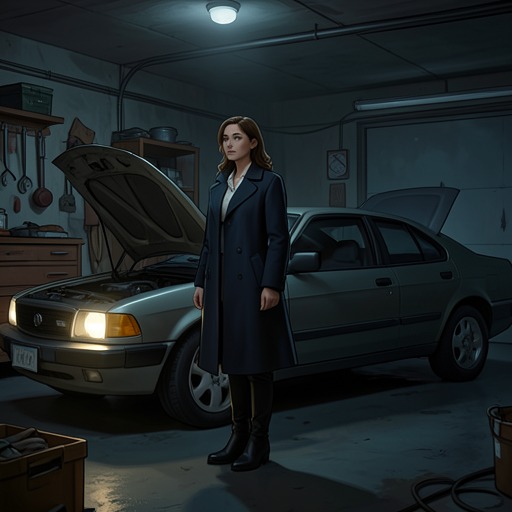
Aza’s ongoing grief over her father’s death
Turtles All the Way DownAza Holmes’s grief for her father is an ongoing bond rather than a past event that the story leaves behind. His death returns in concrete memories, photographs, family conversations, and Aza’s repeated visits to the phone he left behind. The loss is not presented as something she simply overcomes: it remains woven into her understanding of family, memory, and what it means to keep living when someone is absent.
The loss and its remembered circumstances
Aza’s account of her father’s death preserves an ordinary scene made unforgettable by its details. He had been mowing the lawn near the one tree in the family’s front yard when he fell. His headphones were still playing an old soul song through his earbuds; the lawn mower had stopped, and his body lay on its side. At Aza’s mother’s instruction, Aza called 911 and told the operator that her father had fallen. Asked whether he was breathing, she asked her mother, who said he was not. The incongruity of the music continuing while the adults tried to understand what had happened remains sharply present in the memory.
Aza’s mother performed CPR until the ambulance arrived. The family did not know for certain that he was dead until a doctor came into the windowless hospital family room and asked whether he had had a heart condition, speaking of him in the past tense. The remembered sequence moves from a child’s call for help to the belated confirmation of a death; its mundane particulars, rather than an abstract account of bereavement, give the loss its lasting force.
The narrative also places this loss within Aza’s broader sense of life as shaped by forces outside individual control. At White River High School, she reflects that even the time she eats lunch is determined by a bell and a schedule, and that a person may imagine herself the author of her life while circumstances shape its course. This does not make her father’s death an illustration with a simple explanation. Instead, it gives context to the difficulty of accepting an event that Aza could neither choose nor reverse.
A phone that keeps memory close
Aza keeps Aza’s father’s phone and its charging cord hidden in the trunk of Harold, beside the spare tire. The phone is meaningful not because the photographs are unavailable elsewhere—Aza’s mother backed them up to a computer and multiple hard drives—but because the images remain on the device her father used. It still works eight years after his body stopped working, making the phone a practical object that also carries the force of continued presence.
The photographs show the world from his point of view. He took pictures of Aza, Aza’s mother, and, especially, the sky divided by tree branches. During a river trip, Aza sees branches intersecting against the blue sky and remembers similar pictures on the phone. She has wondered what her father saw in that broken-up sky. The recurring image links a present landscape to his attention: the photographs preserve not only who was there, but what caught his eye.
When Aza retrieves the phone and swipes through its pictures, she moves backward through family life. A photograph shows her as a seven-year-old on a playground swing, leaning back toward the camera. She feels that she can remember her father pushing her, his hand against her back, and the certainty that swinging away from him also meant swinging back. Other images show Aza’s mother on a tiny tricycle with Aza on her shoulders, and Aza eating breakfast with cinnamon sugar on her face. Her father is seldom in the pictures because he was usually taking them; when he does appear in a selfie, the framing is often crooked, with someone partly out of the shot. The record is imperfect, but that imperfection belongs to the family life it preserves.
Aza’s favorite pictures of her father are the few in which he is out of focus. She chooses one taken at a Pacers game, with the basketball court behind him and a friend, because blurred features seem true to how people are. The choice resists the idea that memory can restore a person whole. The photographs offer glimpses—sometimes badly framed, sometimes indistinct—rather than a complete return.
Family resemblance and what remains unsaid
Aza and her mother have not been good at talking about Aza’s father. In one conversation, her mother leans her shoulder against Aza’s and wonders whether Aza would have clashed with him. She believes he would have understood Aza’s questions in a way she herself sometimes could not. At the same time, she remembers him as a worrier and admits that his worry could be exhausting. Their exchange makes grief part of a living family relationship: Aza’s mother remembers the man she knew, while also considering the father Aza might have experienced as she grew older.
Aza answers that worrying is the correct worldview because life is worrisome. Her mother smiles and says that Aza sounds just like him. Then she says, “I still can’t believe he left us.” Aza understands that the wording makes the death sound like a decision—as if he had chosen to fall down dead while mowing the lawn. The painful mismatch between ordinary language and an involuntary death shows how the bereaved may speak of absence in terms that cannot quite contain it. Their conversation brings Aza’s father close through resemblance, but also returns both mother and daughter to the fact that he is gone.
Repeated acts of remembering
The phone’s place in Aza’s life is marked by recurrence. Before meeting Daisy at Applebee’s, Aza arrives early and hesitates to get out of Harold. She reaches through the back seat into the trunk, finds a tote bag containing money, Aza’s father’s phone, and its charger, and plugs the phone in until it has enough power to start. She then looks through the photographs. On another night, after Davis drives her home and leaves, Aza goes to the garage for the phone and spends a long time scrolling through images of the sky split by branches. Aza’s mother gently reminds her that those pictures are also on the computer. The repeated return to the device suggests that access to the same images is not interchangeable with access to this particular object.
On the first of these occasions, Aza addresses her father directly. She tells him that she has come into some money, that she will try to do right by it, and that she misses him. The moment does not suggest that the phone can answer or that grief has been settled. Its significance lies in Aza’s act of telling: she brings a present concern to the person whose absence remains part of her life. The old phone becomes a means of maintaining a relationship through memory and speech, even though the conversation can only go one way.
Grief within an unfinished life
Aza’s bereavement remains alongside questions about whether a self can be separated from its circumstances. She wonders whether the same person would exist with money or without it, with a boyfriend or without one, at one school or another. She also says that she cannot choose her thoughts, and cannot decide what happens to her body. Dr. Karen Singh responds that thoughts are thoughts and do not erase Aza’s ownership of herself. These exchanges concern identity and agency more broadly; they do not reduce Aza’s grief to a symptom or make her father’s death the explanation for every difficulty she faces.
The novel’s recurring concern with thought control sharpens the contrast between what Aza can choose and what she cannot. A quotation from William James recommends choosing one thought over another; Aza responds that she cannot choose her thoughts any more than she can choose her name. Her experience of grief belongs to this larger landscape of limits: memory can return, and the phone can be opened, but neither action can undo the death. What Aza can do is keep remembering, speak to her father in the present tense of her own life, and continue living amid losses that do not disappear. Near the end, she says that she misses her father, Davis, and Harold, and concludes that to be alive is to be missing. The statement gives her grief no neat resolution. It places her father among the absences she carries forward.